Showing posts with label Sisters of St. Joseph of Carondelet. Show all posts

Monday, February 1, 2021

CSJs in slave-state Missouri

Map of St. Louis and waterfront in 1840.
St. Louis in 1840 showing location of St. Joseph School for
Negro Girls and proximity to Mississippi River.


Portrait of Sister St. John Fournier, CSJ
Sr. St. John Fournier

AFTER EIGHT YEARS AND TWO MINISTRIES in the little village of Carondelet, Missouri, the small band of CSJ sisters was ready to take on a new mission in the bustling riverfront city of St. Louis. 

The project, near and dear to the heart of Bishop Peter Richard Kenrick, was to be a school for the children of Black Catholics. But for the three sisters who made the short trip to St. Louis, the new mission – and their own charism to “serve the dear neighbor without distinction” – would soon put them in danger. 

The Civil War was still two decades away, but St. Louis in the 1840s was already the epicenter of conflict and controversy over slavery. Slavery was legal, thanks to the infamous Missouri Compromise of 1820, but the white population was a volatile mixture of new organized abolitionist groups and old slave-owning French and American families. Violence was not uncommon. 

Freedmen outnumbered slaves in the large Black population, and agricultural plantations were relatively few. That made St. Louis the scene of a stark and poignant situation – slaves toiling side-by-side with free Black workers in the city’s docks and shipping businesses. Along with that daily reminder of their enslavement, freedom was tantalizingly visible just half a mile away across the Mississippi River. Any slave who could cross it was free the moment he set foot in Illinois. 

Portrait of Sister Protais Deboille
Sr. Protais Deboille
In this tense milieu, Sisters St. John Fournier, Protais Deboille and Antoinette Kincaid opened the doors of the St. Joseph School for Negro Girls on Ash Wednesday (February 5), 1845. According to various CSJ histories, enrollment was between 80 and 100 girls from free families, “all good and well behaved,” and possibly a handful of slave daughters whose more open-minded masters paid for them to attend. The girls were taught reading, writing, arithmetic and other elementary subjects, French (widely spoken in the city) and embroidery – an echo of the CSJs’ lace-making ministry back in France. At no cost, catechism was taught to the rest of the Catholic slave children (including boys) on Saturdays and Sundays.

The school thrived for more than a year, according to a letter Sister St. John wrote in 1873. But it had reawakened simmering anti-Catholic sentiment in St. Louis and infuriated the slave owners. The slaves’ illiteracy kept then from reading abolitionist pamphlets and newspapers and causing trouble. 

Many white Protestants objected to providing slave children and their parents with religious education. According to Sister St. John,

We also prepared slaves for the reception of the sacraments, and this displeased the whites very much. After some time, they threatened to have us put out by force. The threats were repeated every day.

It all came to a crisis one day in 1846.

Closeup of Miraculous Medal - Mary side
Miraculous
Medal

One morning as I was leaving the church, several people called out to me and told me that they were coming that night to put us out of the house. I said nothing to the sisters, and was not afraid, so great confidence had I in the Blessed Virgin! I put some Miraculous Medals on the entrance gate and on the fences (we already had them on all doors and windows of the house).

At eleven o'clock, the sisters woke with a start when they heard a loud noise. Out in the street was a crowd of people crying out and cursing. We recited together the Memorare and other prayers. Suddenly, the police patrol came and scattered those villains who were trying to break open the door. They returned three times that same night, but [the Blessed Virgin] protected us and they were not able to open the door from the outside nor to break it down... The day after our adventure, the Mayor of St. Louis advised Bishop Kenrick to close that school for a time and he did so.

The school never reopened, doomed a few months later when the Missouri Legislature passed law a making it illegal to provide any Black person with instruction in reading and writing. An exorbitant $500 fine was attached, equivalent to tens of thousands of dollars today. Nevertheless, the sisters quietly continued to give religious instruction to Black children.

Although they opened many other schools, that was the end of the St. Louis sisters’ teaching apostolate among American Blacks for almost 100 years, a century of agony that witnessed the Civil War, Reconstruction, Jim Crow and segregated schools. But during the Great Depression, true to their charism of recognizing a need and doing something about it, the sisters started offering a high-quality Catholic education to Black elementary and high school students in the city. It is impressive, but not surprising, that these schools were desegregated (by combining with the sisters’ white schools) years ahead of the Supreme Court’s Brown v. Board of Education decision in 1954. 

Even after they were forced to close St. Joseph’s School, we like to imagine that the sisters continued to minister secretly among the Blacks of St. Louis in defiance of the authorities, going wherever the needs of the people drew them. Perhaps more than one Black child or adult learned to read and write through their help and love. We’ll never know, because the official records don’t tell these stories. But that would be the unstoppable CSJ way.

Decorative map of St. Louis in 1845 showing drawings of the waterfront and prominent buildings.
St. Louis in 1845. Maps from University
of Missouri St. Louis Mercantile Library.
  

The Mount Archives Blog owes a debt of gratitude to the the late Sister Jane Behlman, CSJ, archivist of the St. Louis Province, for writing about the school in her blog Jewels from Jane in 2008. 

Monday, November 2, 2020

Giving their lives

Holy Hope Cemetery in Tucson
Holy Hope Cemetery in Tucson, final resting place of
two CSJs who died in the 1918 pandemic.


AS WE REMEMBER
Portrait of Sister Mary Evangelista Wark, CSJ
Sister M. Evangelista
Wark, CSJ, d. 1918.

our beloved dead during the month of November, let us hold in our hearts eight (perhaps nine) Sisters of St. Joseph of Carondelet whose names are recorded in the archives of the Los Angeles Province. They are listed by location in the order of the day they died, with their age:

Lewiston, Idaho

  • March 30, 1918 – Sister Mary Rose Fee, age 32.
  • October 23, 1918 – Sister Mary Evangelista Wark, age about 32.
  • November 26, 1918 – Sister Mary Clement, age 24.
  • January 3, 1919 – Sister Angelica Heenan, age about 30.
  • January 10, 1919 – Sister Mary Joseph Godsell, age about 32.
  • Nov. 27, 1919 – Sister Mary James Vanderpool,* age 17½ .

Tucson, Arizona

  • January 16, 1919 – Sister Mechtilde Smith, Tucson, age 36.
  • January 21, 1919 – Sister Mary Irene Bertonneau, age 32.

If we look closely, what do we notice?

  • Most of the deaths occurred in a 10-month period.
  • Four died within three weeks of each other.
  • The sisters were young and in their prime – the prime of their lives and the prime of their religious vocations.

Eerily, in these dates, locations and ages of the sisters are the arc of a pandemic – the 1918, or Spanish, Flu. As we mentioned last time we visited this subject, it was the last major contagion to sweep the United States before the current Covid-19 outbreak and a far more devastating plague. It killed more than 50 million people around the world.

Sister Mary Rose Fee, CSJ,
was the first of the Carondelet
sisters to die in the pandemic.
 

The disease (of the strain H1N1) probably started in the American military and came back the same way with the soldiers returning from World War I. As far as we know, the sisters who died were all nurses who contracted it from their patients and died in their own CSJ hospitals, St. Joseph’s of Lewiston and St. Joseph’s of Tucson.

The pandemic tore through the country in three or four waves between 1918 and 1920. The first sister, Mary Rose Fee, died in the first and mildest onset in early spring of 1918. Six more perished in the much deadlier second wave, which arrived in the fall of 1918 and is still notorious for killing young adults in their 20s and 30s. Finally, in an era when girls often joined the convent in their mid-teens, Sister Mary James Vanderpool had already been a sister for two years when she died in the late fall of 1919, not even 18 years old.  

We sometimes forget that the Carondelet sisters of a hundred years ago lived difficult lives of inadequate food, austere living conditions, exhausting work – especially during a pandemic – and constant exposure to the sick. In their hospitals the sisters provided the best medical care the early 1900s could provide, but it was a world without ventilators, vaccinations, antibiotics, and treatments we take for granted today.

Requiescant in pace, all the sisters who sacrificed everything to care for the dear neighbor.

* The Vanderpool family lost a second daughter a year and a half after the first when Sister Mary Alphonsus Vanderpool, CSJ, died in Lewiston on June 11, 1921, at age 19. Although technically not within the period of the pandemic, she may also have been a victim of the Spanish Flu toward the end of the fourth wave. The cause of death for both sisters is listen as “pulmonary tuberculosis,” but Sister Mary James is considered to have died of the flu. 

Death certificates for the Vanderpool sisters, Mary James
and Mary Alphonsus, who died about 18 months apart.
The superior at St. Joseph Hospital in Lewiston,
Mother M. Adelaide, has signed both.


St. Joseph Hospital in Lewiston in 1905.

Sources: Necrologies of the Sisters of St. Joseph of Carondelet, Los Angeles Province; Find a Grave, St. Joseph Medical Center (Lewiston).

Friday, October 9, 2020

The Mount's hidden saint

ONCE UPON A TIME, the name John Henry Newman was a familiar one on the campus of a Catholic college or university – a building, a club, a center. For much of its history, this was true at the Mount, too. The Newman Seminar Room was part of the original architecture of the Charles Willard Coe Memorial library in 1947 until it disappeared in the renovations of 1994-1996. The legacy continues to this day as the Newman Collection of rare books, papers and letters, which occupy an entire wall in Special Collections on the library’s first floor.

Caricature of Newman in
Spy Magazine in 1877 (MSMU
Special Collections)


Today, October 9, we celebrate the memorial of Newman as Saint John Henry Newman, canonized October 13, 2019, by Pope Francis. That his feast day is observed in the early fall of the academic semester is key to knowing who St. John Henry was. Among other things, he was a gifted essayist, novelist, and poet and a prolific one as well. But the work we care about is here is his 1852 The Idea of a University, which influenced the course of Catholic higher education and the liberal arts for the 20th Century and after.

Newman was a gigantic and hugely contentious political figure in 19th Century England. He was a renowned scholar, philosopher and cleric in the Church of England and popular professor at Oxford University. But while still a young man he began to harbor doubts about Anglican theology and starting publishing his questions in a series of pamphlets, or "tracts," sparking an uproar that lasted the rest of the century.

His eventual and very public conversion to Roman Catholicism in 1845 cost him and his followers their families, friends, homes and livelihoods. England was deeply anti-Catholic at the time, with a shocking bigotry that almost mirrors the racial ferment of 21st Century America, so it was no minor thing for Newman to change churches. He was ordained a Catholic priest in 1846 and resettled in Ireland to preach and teach in comparative poverty, and continued to write, often focusing on the problems of moral relativism, which he saw writ large in the Church of England. Not unlike Rev. Martin Luther King, his efforts and sacrifices over decades improved the lot of Catholics in England and he was able to return after 32 years, settling in the industrial city of Birmingham. He was made a cardinal by Pope Leo XIII in 1879 and died in Birmingham in 1890.

The careful reasoning and logic that led him to the Catholic Church made him a hero of Catholics in the United States, who were very much second-class citizens in the early 20th Century (and, believe it or not, regular targets of the Ku Klux Klan). Shut out of other elite schools, Catholics redoubled efforts to build their own colleges on Newman’s model, and further did him homage by forming Newman Clubs on almost every college campus in the country, religious or secular.
 

Newman was a big deal at Mount Saint Mary’s College. The 100th anniversary of his ordination to the priesthood fell on October 27, 1946, and was celebrated with an all-day symposium that included a dramatization of his long poem Dream of Gerontius, lectures by notable Hollywood Catholics and writers, a panel discussion, and choral performances of original compositions by the music faculty setting Newman’s prayers and poems to music.

Members of the Newman Club gather in Brady Hall in 1953.

Newman’s biggest fan at the Mount was Sister Catherine Anita Fitzgerald, CSJ, ’44,  the leader who built Coe Memorial Library in 1947. It was she who insisted on the inclusion of the Newman Seminar Room in the blueprints and the one who filled it with books, art and antiques during her many years as head librarian and faculty member. In the 1950s she formed the Friends of the Library, whose first major fundraising effort was the purchase, at a Sotheby’s auction in 1960, of a large collection of Newman’s books, among them many rare first editions. To the Mount’s Newman Collection, over the ensuing decades, were added newer books as scholarship in Newman’s thought and influence grew and flourished. (Sister Catherine Anita herself wrote articles for scholarly journals and contributed an  article about Newman for the Mount journal Inter-Nos.)  

Other Newman scholars in Los Angeles have occasionally made the pilgrimage to Chalon to use the collection, and it is still mentioned in the Mount catalog as an important library asset. St. John Henry, however, hasn’t been part of Mount life since the 1960s – either in the classroom or at shared events with the Newman groups at USC, UCLA, Loyola and Marymount. In some places, including MSMU, his teachings on liberal arts and Catholic orthodoxy gradually fell out of fashion after the Second Vatican Council in favor of more feminist or social justice-oriented theologies. Sister Catherine Anita, Newman’s on-campus champion, died in 1996 not long after the Newman Seminar Room ceased to exist.

But we hold the collection in trust for the future, because truth never goes out of style – a favorite principle of Newman himself. If you want to commune with a genuine saint – after the Covid-19 pandemic, of course – come to the first floor of the library at Chalon where you will be welcome to browse his books.  In the meantime, we have digitized some of his handwritten letters from our collection (by the way, these are officially second class relics since he became a saint). The PDF will download to your computer. NB: You’ll need to be able to read tiny 19th Century cursive.

Our Lady of the Mount, pray for us. St. John Henry Newman, pray for us! Happy feast day!

A second-class relic with Newman's cursive, from 1831 letter to James Bliss.
(MSMU Special Collections)


Wednesday, March 25, 2020

The Mount, the CSJs, and epidemics

Crowded corridors at Our Lady of Lourdes Hospital in Pasco, Wash.
The photo is undated, probably from around 1950.
WITH THE MOUNT CLOSED due to the COVID-19 pandemic and all of us hunkering down at home, we have been thinking about past epidemics that raced through the United States, all of which impacted the Sisters of St. Joseph of Carondelet -- and later Mount Saint Mary's -- in different ways. Here are some historic highlights from our sources in the University Archives & Special Collections.

Having an epidemic? Build a hospital

The CSJs' hospital in Tucson,
Ariz., in the 1920s.
One of the scourges of the 19th Century was cholera, a water-borne disease spread by human waste and primitive sanitation. It was extremely contagious and often fatal. Those stricken would be healthy one day and dead the next. Germ theory hadn't yet been proposed, so diseases were thought to be transmitted by forms of "bad air" called miasmas, which the steamy Mississippi River next to the CSJs' early settlements seemed to produce. Creeping up the river from New Orleans, cholera struck St. Paul, Minn., in the summer of 1854, less than three years after the the nuns had arrived and before they'd been able to build the town's first hospital. With funding from local citizens and doctors, they started taking cholera victims into an old log cabin. Patients who could afford it paid a dollar a day. At the same time the sisters sped up their plans for a permanent hospital, which became St. Joseph's.

A similar story was repeated by the CSJs in Eureka, Calif., who had barely unpacked their trunks when they were faced with patients suffering from the devastating Spanish Influenza in 1918, a virus that killed an estimated 50 million people worldwide. In Pasco, Wash., CSJs took in flu patients at their tiny Our Lady of Lourdes hospital, just two years old. The sisters in Indianapolis couldn't offer a hospital, but they responded to the pandemic by opening the campus of Sacred Heart High School for outdoor "field" masses on Sundays. Parishioners could practice some "social distancing" and still receive the sacraments.

In the end, the Spanish Flu took a terrible toll on the CSJ community, claiming at least eight mostly young and healthy Carondelet sisters between 1918 and 1921.

Measles at the Mount 

High on a hill in Brentwood, Mount students were isolated in a unique way, but they weren't immune from virus outbreaks. The "Mountain Ear," a weekly gossip column in the The View newspaper (mountaineer -- get it?) reported humorously on March 20, 1957, that a local epidemic of measles had infected four students and possibly six in Brady Hall, including the editor. If a gossip column sounds unserious, it's because in the decades before the measles vaccine it was a very common childhood disease, and most Americans, including Mount students, had developed the immunity. There's no evidence the measles spread. Over the decades, The View reported an occasional student with an embarrassing case, and no one gave it a second thought. It wouldn't be until 2015 when parents' failure to vaccinate their kids led to a dangerous global outbreak, that everyone started paying attention. The warnings show up in recent student newsletters.

The polio scourge

A childhood case of measles is one thing, but another childhood disease caused absolute terror in mid-20th Century. Although there were many polio outbreaks in the 20th century, the epidemic after World War II was the most terrifying. Starting around 1947 in California, it wasn't stopped until 1955 and the release of the the Salk vaccine. The worst year was 1952, one of the largest outbreaks in U.S. history. Cases that year of poliomyelitis, also known by its starker name infantile paralysis, numbered almost 60,000 in the U.S. Three-thousand children and young adults died, and more than 20,000 were left with permanent mild to severe muscle and nerve damage, including paralysis.

Up on the Brentwood hilltop Mount student were relatively safe. Science and nursing majors studied the disease intently, receiving advice in the columns of The View about what scientific articles to read.  Recruited by ads in the paper, many students responded with regular blood donations for the Red Cross after it was discovered that gamma globulin, a blood component, boosted the immune system and was effective in reducing the symptoms of polio and and other serious diseases.

Adelaide Spuhler Mealey '49
Students at a a Family Day event in 1954 heard a talk from an alumna about day-to-day living after surviving polio. Adelaide Spuhler Mealey, '49 contracted polio after her marriage but was able to care for her two toddlers from her wheelchair.

Virus research

No blog on viruses and MSMU can fail to mention our famous CSJ biologist, Sister Mary Gerald Leahy, whose pioneering research in the 1960s on mosquito reproduction was surfaced anew during the Zika virus epidemic in 2016. Rampant in South America, the Zika virus is spread by aedes aegypti mosquitoes -- which Sister Gerald actually raised in St. Joseph Hall -- and can cause serious birth defects if the mother contracts it during her pregnancy. The epidemic struck at the time of the 2016 Olympics in Rio de Janiero, foreshadowing the current debate over canceling the 2020 Summer Olympics. The Rio Games went on as planned, but because of Covid-19 the Toyko Olympics have been postponed.  

Coronavirus

Wildfire, epidemics -- never has the Mount been entirely closed in its history until now. The wonderful benefits of transportation and travel mean that the safety and isolation of the mid-century Mount and earlier is almost a dream. But the students of the early 1950s, sweating out the polio epidemic, didn't have smartphones, online classes, Zoom or digital article databases. The common thread is that we live with uncertainty and sometimes fear, but life always manages to go on.

And while all of Los Angeles is on lockdown, maybe we will have a little more time for this blog! Stay safe, stay healthy.    

Sources

We have access to so much wonderful stuff. Check out Sister Mary Agnes Rossiter, CSJ, A Sketch of Her Life by Sister Lucinda Savage, CSJ (1947), which mentions the Spanish Flu. The CSJs' early hospitals and cholera epidemics are mentioned in The Century's Harvest 1836-1936, also by Sister Lucinda. Digital copies of The View and all our digital collections can be viewed at http://stmary2.sdlhost.com.

An advertisement from The View on February 16, 1957, urges students
to donate blood to create gamma globulin to fight polio and other diseases.

Friday, September 7, 2018

Poem for a feast day

Nativity of the Virgin by Giotto di Bondone [Public domain].
Downloaded from Wikimedia Commons Sept. 7, 2018.
THE SISTERS OF ST. JOSEPH OF CARONDELET, our university's founders, count many poets among their members.  As an archival reflection for the Feast of the Nativity of the Blessed Virgin (also known as Jesus' mother), September 8, we offer these short lines from Sister St. Catherine Beavers, CSJ. We invite you to consider how she poses the smallness of a human mother and her baby daughter with a hint of the the supernatural — and in so few words.
 Nativity of our Blessed Mother (1931)

A tiny crib – a sacred place
A tiny place where angels trod.
A tiny babe – a child of the earth
A mother of a God.
Sister St. Catherine – aka Mother St. Catherine (d. 1945) – was the Provincial Superior (1917-1923) right ahead of our founding president, Mother Margaret Mary Brady.

When the Mount was founded in 1925, Sister St. Catherine was included as a special “councilor” to the new college, although she was also missioned as the head of Our Lady of Peace. When she stepped down as provincial, the University of Southern California honored her with a master of arts degree pro merito.

We have copies of her volume of poetry published in 1931, A Thought at Christmastide and other Poems, at the CSJ Institute Library on the Doheny Campus and here in Chalon Special Collections.

Thursday, March 1, 2018

Prophecy on the Mount

Abigail McCarthy, right, is greeted by Sister Magdalen Coughlin, CSJ, left,
during a visit by McCarthy to the Mount in 1968. Looking on are CSJ faculty
members Sisters Eleanor Francis Powers and Catherine Therese Knoop.
Sister Magdalen, later MSMU President, was on the faculty at the time.
She and McCarthy were fellow alumnae of St. Kate's University.
THE MISSION STATEMENT of the Sisters of St. Joseph of Carondelet mentions "prophetic witness."

Well, have we got some prophecy for you.

Forty years ago – a biblical number to be sure – a prominent woman in public life delivered some predictions during a visit to MSMU that are so startling in their accuracy that we thought we would share them to kick off Women's History Month.

In 1978, Abigail McCarthy was the estranged wife of Sen. Eugene McCarthy (D-Minn.) and a decade past his historic, divisive run at the presidency of the United States. An outspoken writer and opinion-maker in her own right who had visited the Mount in 1968, she was invited to deliver the Siena Day (academic symposium) keynote in February (reported in The View), titled "Christian Woman: Towards a 21st Century."

She predicted:
  1. Fewer women will be married in the 21st Century, and of those who are half will be [single] heads of households. And this: "There will be no such thing as permanent commitments in the 21st Century."
  2.  There will be a larger number of independent nations, but fewer democratic republics.
  3. "The [Catholic] Church will become a remnant in society" but the pope will be a symbol of unity.
  4. There will be "less privacy and independence in small matters because computers are making our lives available to others."
Think about it: How did she foresee the startling decline in the rate of formal marriage and rise in single motherhood? The crumbling of the Soviet Union more than 10 years before it happened and the worldwide struggles for democracy? The shrinking population of practicing Catholics and the global popularity of Pope Francis?

Number 4 is the one that really gets us. In an era before personal computers and smartphones, how in the world did she ever anticipate the effects of Facebook, Twitter, Instagram and the digital privacy issues we contend with today?

We think the answer lies in the fact that Abigail McCarthy was a woman educated and formed by the Sisters of St. Joseph of Carondelet. At a women's college she learned to lead. She learned to think as a prophetic witness, to read the signs of the times and act on them.

McCarthy received her B.A. at the College of St. Catherine (now known as St. Kate's University) in St. Paul, Minn., the CSJ school that educated so many members of the Mount's own religious community, including two presidents.

After college, Abigail Quigley met her future husband, a former Benedictine monk, at the small rural school in North Dakota where they were teachers. Both devout Catholics, they spent their first years of married life on a social justice mission, a Catholic farm commune in Minnesota. "Gene" McCarthy went on to be a Farm Labor Party and Democratic congressional representative from Minnesota and was elected to the Senate in 1958.

He is best remembered as the presidential candidate who challenged Lyndon B. Johnson and the Vietnam War in 1968 (playing a role not unlike Bernie Sanders') in that notorious election year. An Archives picture records Abigail's first visit to the Mount during a campaign swing through Los Angeles, probably around the time of the California Primary Election in June 1968 (photo above).

The very next year, after losing the election, Gene left Abigail and their five children for his long-time mistress, a television news reporter. But as Catholics the McCarthys never divorced.

Abigail McCarthy, who died in 2001, went on to build a successful career as a writer and commentator, an articulate voice for the place of women in the Church, in politics, in social justice, in everyday life.

In other words, hers was a life of prophetic witness in the CSJ sense. But as a prophet, Abigail McCarthy gave it a whole new meaning.

Wednesday, March 16, 2016

385 Years of Service

One of our favorite photos in the MSMU Archives: Sister Regina Clare
receiving her PhD in Education in 1972, which turned out to be USC's 100th in
that department. She was dean of graduate and undergraduate programs
at the time based at the newly renamed Doheny Campus. She is celebrating
seven decades as a Sister of St. Joseph of Carondelet.


SIX OF THE MOUNT'S SISTERS are celebrating Jubilees this week during the festivities surrounding the feast of the CSJs' patron, St. Joseph. Together, they've given an astounding 385 years of their lives to the CSJ mission: to do all of which woman is capable (in the words of their guiding light, Father Jean Pierre Medaille, S.J.) in serving the dear neighbor.

Three hundred and eighty-five years: That is an average of  64.16666667 years apiece. That number is skewed upward a bit by the tremendous vocation of Sister Constance Fitzgerald, 102, celebrating 85 years as a Sister of St. Joseph of Carondelet. 

Many of these Sisters' vocations were lived out at Mount Saint Mary's University. Three of the six are alumnae, and all of them taught and/or performed administrative duties. Many had second and third careers after the Mount; as long as there were works of mercy to be done in the world, they were there to do them, continuing to help even in retirement.
  • Sister Judy Diaz Molosky, 50 years - Founded the Center for Urban Partnership on the Doheny Campus, coordinating service learning activities for MSMU students at downtown social service organizations. Mount alumna with B.A. in Mathematics.
  • Sister Sandra Williams, 50 years - Current Mount Trustee and member of the CSJ Leadership Team. She is a Mount alumna with a B.A. in Spanish.
  • Sister Joan Henehan, 60 years - Former Mount Trustee, formerly chair of the Religious Studies faculty, associate director of the Spiritual Life Program on the Doheny Campus. Mount alumna. 
  • Sister Cecile Therese Beresford, 70 years - Chair of the Home Economics faculty at MSMU and former member of the CSJ Congregation Leadership in St. Louis.
  • Sister Regina Clare Salazar, 70 years - Member of the Education Faculty at MSMU and founder of the Mount’s first evening and weekend program at Chester Place in the 1950s. Became one of the early administrators of the new Doheny Campus starting in the 1960s. After MSMU became President and CEO of Daniel Freeman Hospital and now oversees the care of retired Sisters at Carondelet Center.
  • Sister Mary Constance Fitzgerald, 85 years - Longtime Doheny Campus resident and an alumna of Mount Saint Mary’s. She taught creative writing and child development during summer sessions at MSMU and volunteered in the Learning Resource Center. 

We've put some pictures up on Facebook showing recent pictures of the Jubilarians along with some from yesteryear:
Posted by Mount Saint Mary's University Archives on Wednesday, March 16, 2016 
Sister Constance Fitzgerald shown tutoring a student at Doheny in 1999 when she was
 a mere 85 years old. Now 102, she is celebrating 85 years of service as a CSJ.

Wednesday, December 23, 2015

An {Unstoppable} CSJ Christmas


Religious faculty celebrates Christmas in Brady Hall, 1961.
At right learning on an elbow is Sr. Aline Marie Gerber.
EVERY PICTURE TELLS A STORY. One tiny image in our "Sisters in Traditional Habits" file shows the Mount's Sisters enjoying each other's company in Brady Hall.

At first glance, it's a not-very-interesting Christmas snapshot. But if you know some Mount history, there's a story behind the setting: the old Lecture Hall, now Brady Lounge.

According to the back of the photo the year is 1961. Scores of holiday greeting cards are pinned to the stage curtain in the shape of a row of Christmas trees. A real tree, off to the right, is festooned with tinsel and more cards. What appears to be a pile of newly unwrapped presents -- mostly books -- is beneath the tree.

Christmas, 1961: Just six weeks before this photo was taken, the notorious Bel Air Fire swept through Brentwood Heights, damaging or destroying about a fifth of the Chalon Campus and doing serious damage at Carondelet Center. Burned to the ground, with everything in it, was the Faculty Residence (Rossiter Hall). Mercifully, no one was hurt, but many of the Sisters lost all they had.

But soon it would be time for the holidays! Although the campus was still grimy with smoke and the air reeked of burned wood, we can be sure Christmas would proceed as planned in a new location.

Other details are only hinted at in this 54-year-old picture. Were there more cards than usual that Christmas? Were the donations tucked inside extra-generous after the fire? Did that load of new books under the tree replace some of the faculty's lost teaching materials? We can be fairly sure the answer to all of those questions is yes.

After the party, the Sisters would scatter to their temporary homes -- other CSJ convents, hospitals, or the Mount's dorms where they would spend the next year. There was a new semester to prepare for, and reconstruction on damaged buildings was already under way. Funds had to be raised for new buildings. The Mount and the CSJs' community life had to keep moving forward, fire or no fire. 

But Christmas in 1961, as it is in 2015, was a special time at the Mount. For an afternoon, at least, our {Unstoppable} Sisters could relax and enjoy some Christmas cheer in familiar, if makeshift, surroundings.

Monday, November 30, 2015

Genealogical secrets


The last chapter of the Gospel of Mark and beginning of  Luke in Dutch.
This is a guest blog by MSMU Archives Asst. Nancy L. Steinmann, MLIS. Nancy has been working on a project to prepare some of  MSMU's oldest books for formal cataloging. 
A HIDDEN TREASURE surfaced in the Mount Archives last week during some routine assessment of special collections volumes. The rare 1878 Bible in Dutch revealed family genealogical information written on the flyleaves and on inserted loose leaves in the volume.

The entries for the families DeGries and Hoverleden document births and deaths ranging from 1843 to 1940. Few clues for the origin of the Bible exist except for a small note tucked inside the leaves saying that it was donated by “Sister St. Michael.” She later went by Sr. Michael Flaherty, CSJ, of the Los Angeles Province of the Sisters of St. Joseph of Carondelet, who passed away in 2012 at the age of 86.

The Bible was in a very poor state of preservation, with the pages crumbling due to natural acids (lignin) in the wood-pulp paper. While rare, it had little monetary value due to its condition. However, the family information preserved in the context of the volume provides priceless evidence for genealogical research. But first it must be made available to potential users.

In accordance with our deaccession policy, the MSMU Archives searched for a repository with similar materials to house the volume. A centralized national repository would allow the materials and their historic information to be easily located. The National Genealogical Society (NGS) in Arlington, Va., happily responded.

Organized in 1903, the NGS exists to provide education and training to the genealogical community, promoting access to and preservation of genealogical records. The organization will scan the family information and add the names to their extensive database of Bible records The volume itself will be stored in the Daughters of the American Revolution (DAR) Library in Washington, D.C., with the rest of the NGS Bible collection.

In its new home, this rare Bible will add to the growing treasure of genealogical information available to online users, connecting families to their past, and preserving the gracious donation of Sister St. Michael for future generations.

For further information about these genealogical resources, please see:


Thursday, November 12, 2015

Doheny books go home to No. 8

Ned Doheny's bookplate showing No. 8, the "Ranch"
in Beverly Hills, the oil well
Casiana and the family
yacht of the same name.
ESTELLE DOHENY WAS A WORLD-CLASS collector of rare books, something that may have rubbed off on her stepson, Edward L. “Ned” Doheny Jr. (1893-1929).

Ned left behind a run of collectibles printed by the Bibliophile Society that occupied a dozen feet of bookshelf in the Doheny Mansion, from the family’s first years there to Estelle Doheny’s death on October 30, 1958. In early 1959 they came to the Mount libraries’ Archives & Special Collections.

But now after months of planning they’re back in their original home of 100 years ago. To accommodate an influx of historic books in the Chalon Library, the decision was made to use Estelle’s glass-fronted bookshelves in her personal library at No. 8 Chester Place as a permanent place of honor for this collection of Doheniana.

The Boston-based Bibliophile Society was a sort of book-of-the-month club for well-to-do readers. Classics and new titles were issued in limited press runs of letterpress on handmade linen- or cotton-rag paper. The spines are almost all vellum with embossed gold, the various bindings made of leather, paper or cloth. Inside each cover is Ned’s personal bookplate, which depicts four of his five children and vignettes from the family’s history – including No. 8 itself, Edward Doheny Sr.’s first oil well and the Dohenys’ yacht, both called “Casiana.”

Estelle Doheny added her own bookplates opposite Ned's.
After Ned’s tragic death in 1929 the books remained with Estelle, who placed two of her own ex libris (from the library) plates opposite Ned’s. When the Mansion became a convent for the Sisters of St. Joseph of Carondelet shortly after Estelle's death at the age of 83, the books were given to the Mount's Charles Willard Coe Memorial Library. And there they remained for the next 56 years.

The relocation project wouldn't have happened without our excellent library volunteers Dianne Plou Schautschick ’65, Emily Deutsch Keller ’66 and Vivian Santibáñez, who did all the packing up at Chalon and shelving at Doheny. H/T to Mary Uganskis for her numerous rounds of inventorying and to Samantha Silver and Terri Fresquez of the library staff for quickly re-cataloging 139 volumes. It’s gratifying to see Ned’s books restored to their historic home.

Emily and Vivian critiquing the final arrangement.
(iPhone 6 photo by Dianne Schautschick)

Thursday, October 29, 2015

Sisterhood in the archives

Sister archivists from the CSJ Provinces in front of the Charles Willard
Coe Memorial Library on the Chalon Campus.
WE WERE PRIVILEGED on Wednesday to host seven VIPs from our venerable profession – the province archivists of the Sisters of St. Joseph of Carondelet.

The CSJs are facing the same issue as many, if not most, religious orders in the United States: dwindling numbers. The post-World War II years saw a tremendous run-up in vocations to religious life and monasteries and convents bursting at the seams. That phenomenon is now viewed as a "blip," and these days things have returned to something more normal.

This presents a challenge for the current members, though, in the form of large facilities and fewer people to take care of them. (See Carondelet Center, below, home of the Los Angeles Province. There are about 325 CSJ sisters in the province today.)

Many religious orders are consolidating operations in their larger facilities, including archives. Archives are possessed of a couple important features: They're bulky, they cost money to maintain and sustain, and they're irreplaceable.

The archivists of the provinces of Los Angeles, Albany, St. Paul, St. Louis, and Hawaii (a vice-province) are meeting at Carondelet Center this week to discuss the logistics of consolidating their physical archives, a topic that has been front and center for the archivists for the last few years. Already the archives of the Congregation headquarters in St. Louis (what used to be known as the motherhouse) have been consolidated with provincial archives at Avila University in Kansas City, KN. Hawaii is preparing to transfer its archives to Los Angeles.

In a situation like this, the subject of digitizing the CSJ Archives is bound to come up. We can say without exaggeration that the combined collections of the CSJs comprise a historic resource of national importance. Religious sisters were a vital, and often overlooked, resource in the founding of the United States. Their schools and hospitals were frequently the first such facilities in the new territories. The provincial archives hold priceless communications and records that tell these stories, and they don't end with the settlement of the frontier. Scholars will be studying the history of religious orders for decades – centuries – to come.

Digitization offers the promise of broad access, but it comes with a host of problems of its own. It seems like a no-brainer solution on the surface, but digitized archives demand money, stable management and continuity that virtually all institutions will be hard-pressed to provide when one considers the availability of the data in 100 or 200 or 500 years.

It made for some lively conversation among this sisterhood of archivists, the CSJs with their 365-year history and we Mount folks with our 90. We at MSMU have some experience with mass digitization to offer them, and are proud to be asked for our counsel.

Archivists are colleagues in this business of history, but for the Mount Archives, helping to usher the CSJ Archives into the future is a privilege and a solemn responsibility. What better way for us to demonstrate "the Spirit of the Founders," one of the key components of the University's strategic plan? The brains, good cheer and enthusiasm of our sister archivists are beyond inspirational – their mission is our mission.

Once referred to as the House of Studies, Carondelet Center was
built in 1955 to house and educate hundreds of young CSJs. Above to the
right is the Chalon Campus.

Thursday, January 29, 2015

An {Unstoppable} Sister


Sister Mary Evelyn, center, with some of the Education faculty in 1975.
THE UNIVERSITY IS MOURNING the passing of one of its longtime faculty members, Sister Mary Evelyn Flynn, CSJ, who died January 21 at age 87. A Mount alumna, she was a professor and academic adviser for more than 30 years, mostly in the Education Department. And, typical of our CSJs, she was a lot more besides.

Sister Mary Evelyn Flynn '53 at her day job in 1978.
She entered the Sisters of St. Joseph of Carondelet on September 1, 1944, and earned her BA degree in English in 1951. After years in elementary education and administration at the Archdiocese level, Sister Mary Evelyn earned an M.A. in Education at the Mount and M.S. in Reading Specialization at  USC. She joined the Mount Education faculty in 1971.

But teaching was just the day job. She did double and triple duty beyond the classroom, serving as faculty moderator to different student organizations and the ASB, and as dorm "mom" – technically "floor warden" in Brady Hall in the 1970s. She accompanied students on their summer trips to Europe and volunteered for the long-running Phonathon annual fundraiser.

Students, staff and faculty showed their appreciation by naming her "outstanding adviser" more than once. She provided academic advisement in Education, English, Liberal Studies and even Nursing, and watched with pride as 30 of the Education Department's advisees received awards from the prestigious Rockefeller Bros. Fund.

She was one of the recipients of a CAPHE grant in 1988 to do research into the best methodologies for meeting the needs of the Mount's rapidly changing student demographics. Her topic was peer coaching in a highly diverse environment. (CAPHE stands for Consortium for the Advancement of Private Higher Education; the grants for diversity research were also funded by the Times Mirror Foundation.)

An earlier grant from the National Endowment for the Humanities in 1985 enabled her to study children's literature, for which she had a special love, at the University of Connecticut.

In her spare time (did she have spare time?) she loved to read, confiding to the Oracle campus newspaper in March, 2000, that she liked
almost all children’s books. I also like mysteries and biographies…  a lot of things! But I don’t like books by authors like Stephen King.
Sister Mary Evelyn, left, with former academic dean
Father Matthew Delaney and Prof. Wanda Teays
in November, 2005.
Sister Mary Evelyn was into her 80s before she finally retired from active mission at MSMU. We offer our condolences to all her Sisters in the CSJs’ L.A. province, especially her sibling Sister Daniel Therese Flynn, CSJ ’60.  Blessings on all the {unstoppable} Sisters and what they’ve done and continue to do for the {unstoppable} Mount.

CSJ Appreciation Day at MSMU in March, 2004. Sister Mary Evelyn is
on the far right. Her sibling Sister Daniel Therese Flynn, CSJ, '60 is second
from the left in the front row.
Note: Dates for Sister's entry into the CSJs and degrees were later updated with new information from the CSJ Provincial Archives. -  Ed.

Thursday, July 31, 2014

Welcome, CSJ Chapter

The Sisters of St. Joseph of Carondelet, Los Angeles Province, are holding their annual Chapter for the next few days and many of them are coming home to the Chalon Campus where they were once students.

We gave a ride up the hill to Sister Dorothy Ann Lesher, CSJ, of Tucson, who entered religious life in 1955 and graduated from the Mount. As we were parking, she recalled fondly the many hours she spent hitting the books in Coe Library.

Here's our Twitter feed for Throwback Thursday welcoming the CSJs to Chalon with a cute picture from the Archives:

Thursday, July 18, 2013

Capturing Doheny's calm beauty

Cool blues with a sunset sky bring the quiet and peace of
Chester Place to life. St. Vincent's looms in the background.
LOS ANGELES ARTIST AND AUTHOR Leo Politi is known for the special way he rendered our city in vibrant colors and bursting with activity, celebrating its ethnic diversity years before anyone started paying attention.

He could also paint stillness and quiet. Should anyone be surprised that he found them at Mount St. Mary's College?

The image above is from Tales of the Parks of Los Angeles, Politi's 1966 tribute to the most inviting cityscapes (Palm Desert, CA: Best-West Books). The Mount's copy was found earlier this week in Coe Library storage and will be cataloged and join several other Politi books in Special Collections.

Politi  numbered among his friends many Sisters of St. Joseph of Carondelet and visited them at Chester Place, which in the mid-1960s had recently become the Mount's bustling Downtown Campus. But he came to paint after the students had departed and the grounds were returned to the resident nuns.

With the flowers in the Wishing Well providing the only bright splash, Politi captures the cool calm of the campus. The nuns are preparing for evening prayer at the end of what had surely been a very busy day for them.

Please see our Facebook page for additional pictures of Chester Place by Leo Politi, and you're invited to visit the Spearman Room in the Chalon Campus library if you'd like to see the originals.


Monday, March 18, 2013

The 2013 Jubilarians

Jubilarian Sister Daniel Therese Flynn '60 with a beaming student
at Doheny graduation. Picture is probably from 2003.

IT'S ST. JOSEPH WEEK, the annual event honoring the patron saint of the Sisters of St. Joseph of Carondelet and a time when we honor all the CSJs with strong ties to the College, especially those Sisters celebrating their anniversaries in the Order. They all continue to provide remarkable service long after ordinary people would be thinking about retirement. Here are some thumbnail sketches of the 2013 honorees from the archives of the CSJ Los Angeles Province and MSMC.

70 Years

Sister Monica Anne, RIP
  • Sr. Monica Anne Waldman. Supervisor of Student Dining Rooms 1950s and 1960s. She enjoyed working with and helping the Mount students. She passed away in November. 
  • Sr. Loretta Anne Bellue – Worked on both campuses in the 1980s and early '90s in the bookstore and was available as a driver to the sisters needing transportation.

60 Years

  • Sr. Teresa Avalos – After 25 years of ministry in Peru, she came to the Mount on sabbatical in 1988 and worked there in the late 1980s.
  • Sr. Daniel Therese Flynn '60 – A Mount grad, she has been on the SPR faculty since 2000 as a writing and reading instructor at the Doheny Learning Resource Center. She currently serves as the COSA Chairperson.
  • Sr. Patricia Foster M'87 – A master's grad, Sister worked at the College from 1993 to 2004 as an administrative assistant in different departments. 
  • Sr. Kathleen Kelly '59  – This Mount graduate has held numerous roles including Vice President of the Doheny Campus and Dean of the Associate of Arts program.
  • Sr. Rose Leonard Stevling – After teaching at Doheny, Sister served as director of the Doheny Liberal Arts Program and director of Doheny Advisement Center in the 1980s.
  • Sr. Patricia Supple – Founder and director of the Chalon Library Media Center in the 1970s, Senior Board advisor and Carondelet Hall resident advisor.
Jubilarian Sister Patricia Supple, center, was advisor to the Senior Board
in 1979. She went by Sister Michael Patrick in those days.
Photo from Mount Archives Collection online, http://bit.ly/UBq7Nm.

Tuesday, July 24, 2012

Welcome to Doheny, 1962

Picture courtesy of the Carondelet Center Archives. Used with permission.
WE SPOTTED THIS PHOTO on the "Archives" page of the December, 2011, edition of Designs, published by the CSJ province in L.A. (Vol. 28, No. 10, p. 19). Sister Patricia Rose Shanahan, CSJ, the province archivist, was kind enough to send us a copy for the Doheny 50th anniversary celebration.

The seven CSJs have posed on the marble verandah of the Doheny Mansion. We're thinking that this is a formal portrait of the inaugural Associate of Arts faculty on the Downtown Campus, as it was known then. That would date this picture to the opening of the Associate of Arts program in the fall of 1962.

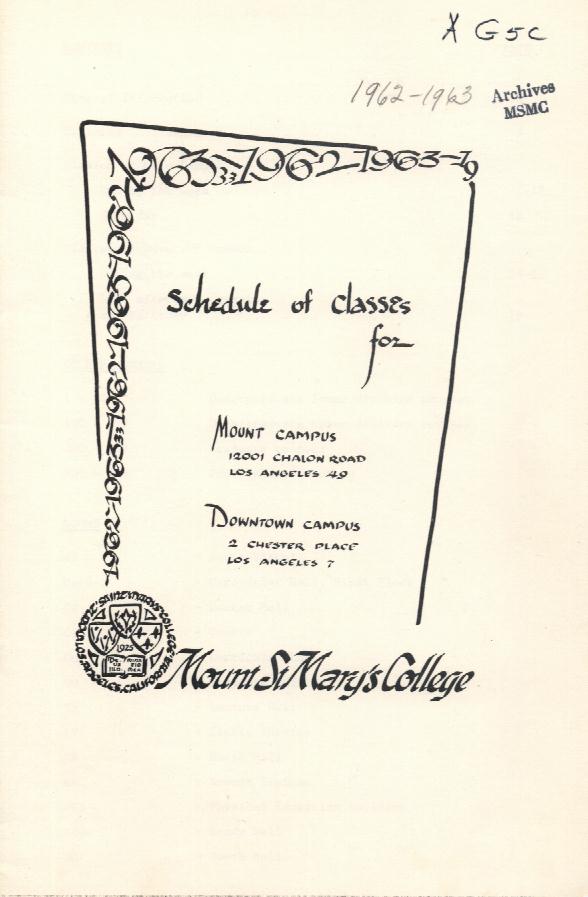
First schedule, with hand-lettered cover, 
for the two campuses, Fall 1962.
A quick look at the class schedule confirms that these are some, but not all, of Doheny's first religious faculty, along with the Mount's then-president, Sister Rebecca Doan (third from left).

Sisters from left to right with the courses they taught are: Mary Williams (Language & Literature, Journalism), Regina Clare Salazar (Educational Measurement in the teaching credential program), Rebecca Doan, Raymond Mary Braun, (Typewriting, Shorthand and Business Math), Eloise Therese Mescall (Spanish and French conversation; she was also the inaugural director of the Downtown Campus), Mary Irene Flanagan (Apparel Construction and Personal Appearance, Food Management for Homemakers, Child Study and Family Relations), and Mary Helen Pettid (History of the United States).

There were, of course, many other religious and lay faculty members teaching almost 80 classes and labs, with eight faculty covering 26 classes in the Music Department alone. Other offerings were in Art, Secretarial Science, Economics, English, Health and Physical Education, Home Economics, Modern Languages, Philosophy, Psychology and Theology. Classes ran from 8:10 a.m. into the evening and all day Saturdays. A parallel "Sister Formation" program was offered for religious teaching in Downtown parish schools.

On the day it opened, September 12, 1962, Doheny was a very busy place.